
WHAT IS PECTIN?

APPLICATION OF PECTIN

Pectin is a food additive (E-440), produced from apple, citrus, beet, etc. canning production waste. It has pronounced health, protective and therapeutic properties. The raw materials used to produce pectin in Pulvit are apple and citrus fruit squeezes and beet pulp.

The main use for pectin is as a gelling agent, thickening agent and stabilizer in food. The classical application is giving the jelly-like consistency to jams or marmalades, which would otherwise be sweet juices. Pectin also reduces syneresis* in jams and marmalades and increases the gel strength of low-calorie jams. For household use, pectin is an ingredient in gelling sugar (also known as “jam sugar”) where it is diluted to the right concentration with sugar and some citric acid to adjust pH.

Pectin is employed in the pharmaceutical industry as a carrier for drug delivery to the gastrointestinal tract such as matrix tablets, gel beads and film-coated dosage forms. Pectin increases viscosity and volume of stool so that it is used against constipation and diarrhea. It has been used in gentle heavy metal removal from biological systems. Pectin is also used in throat lozenges as a demulcent.
Currently, scientists in many countries of the world investigate the properties of pectin discovering ever new healing effects creating options for expanding the application of pectin in various industries.
Being a primary gelling agent and thickener, pectin, also known as the E440 food supplement, is widely used in the food industry for producing canned foods, bakery, sauces, and dairy products; blended juices with high volume of pulp; jams, sausage products, food concentrates, fruit wines and other alcoholic beverages.
The health care industry is the second major consumer of pectin. The importance of pectins has sufficiently grown during the last three decades due to discovering the ability of pectin to expel various harmful agents such as heavy metals, long life radio nuclides of cesium, strontium, yttrium, and other nuclides with disintegration periods of decades, from the human body. The absorbent quality of pectin is used for expelling nitrates, free radicals, metabolism products, xenobiotics, biogenic toxins, anabolic steroids, and harmful substances as well as substances accumulated in the body, such as cholesterol, bile acids, urea, mast cell products, and many other toxins.
See our market analysis for more insight about economical value of our approach.
Pectin is also a valuable antioxidant. Its application in the health care expands over preventing industrial disorders, treatment of digestive system, healing wounds, prevention of colon cancer and many other diseases. A very important application of pectin is stabilizing the glycemic index for diabetes patients.
In fact, several countries have implemented legal acts obliging the use of pectin for treating employers operating in hazardous conditions.
The pharmaceutical industry uses pectin for producing children’s granules, suspensions, as a viscosity agent in emulsions for absorbing heavy metallic ions, for treating wound and producing nutrition media.
Other applications of pectin include cosmetology for preparing wide spectrum of gels, specific facial masks, etc. Pectin is also used for various technical purposes such as production of D-galacturonic acid.
By and large, the properties of pectin make it an important component with constantly growing demand for mentioned industries, as well as in the dairy, bakery, perfumery, cosmetology, canning, pharmaceutical, textile, typography, etc.
PECTIN MARKET IS GLOBAL
For example, both European and Asia Pacific countries are witnessing increasing demand for pectin mainly in the food & beverages industries. Europe constitutes the largest share of the global pectin market due to the high demand for convenience foods & functional dairy products and increasing consumption of jam & jellies and baked goods.
Asia Pacific is likely to become the fastest-growing region in the global pectin industry. The growth in the market is driven by the growing demand for convenience foods, functional dairy products, and baked goods, coupled with the changing consumer lifestyle in the region.
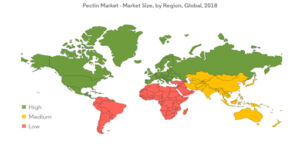
Europe holds the largest market share in pectin market, followed by North America. The demand in the region is high due to the presence and growth of end-use application for the product. Brazil is one of the largest producers of pectin, followed by Denmark and Mexico. The production of pectin in Argentina is conditioned by unsuitable weather patterns for growing relevant cultures.
RAW MATERIALS AND SUPPLIERS
Our technology uses agricultural waste as raw material, making the production even more than 100% ecologically pure and environment friendly.
The raw material base is wide and accessible. Dry citrus pulp is purchased in Turkey, Argentina, Brazil, India, Vietnam, China, etc. There are agreements with industrialists from Israel, Argentina, Brazil and Turkey to supply the original citrus material. Using apple and beetroot source material is also a common practice.
MARKET ANALYSIS
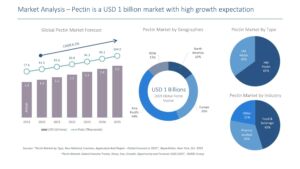
With constantly growing demand for pectin and related products, the market looks favorable for new players. Read more about the application of pectin in various industries.
Pectin production increases annually by 6-8%. The cost of pectin for the food industry in the world market is 25-35 US dollars per 1 kilogram, (preformed, packaged in the form of tea bags or pet container- from 50 to 85 $/kg.) and for the medical supplies – from 40 to 120 US dollars. That said, the production growth rate lags behind the industrial demands leaving open opportunities for new manufacturers all over the world.
Our ecologically pure technology produces dietary fiber, which is also of great demand in the industry. The selling price for the edible fiber constitutes from 4 to 16 dollars per kg. (preformed, packaged in the form of tea bags or pet container – from 25 to 40 $/kg). This opens an additional opportunity for expanding your marketing activities.
The pectin market size is estimated to a value of USD 1,0 billion in 2019 and is projected to grow at a CAGR of 6.5% from 2019, to reach USD 1,5 billion by 2025. The increasing consumption of convenience food, rise in health consciousness, and diverse applicability of pectin drive the growth of the pectin industry.
Estimates show that the minimum demand of the world population and world food industry could reach more than 160,000 tons per year.
Let’s take a look at the major players on the contemporary pectin market. Hercules (USA) is the largest pectin manufacturer in the world. Hercules owns nine of eleven production facilities operating in Europe, including the world’s largest pectin plant, Copenhagen Pectin A / S, Denmark. Total capacity of these eleven plants is over 2 thousand tons of pectin per year. Other major producers of pectin are Herbstreit & Fox KG, Germany, Obipectin, Switzerland and Danisco, Denmark. Comparing this data to the demands, we clearly see a gap, which our technology is intended to fill.